
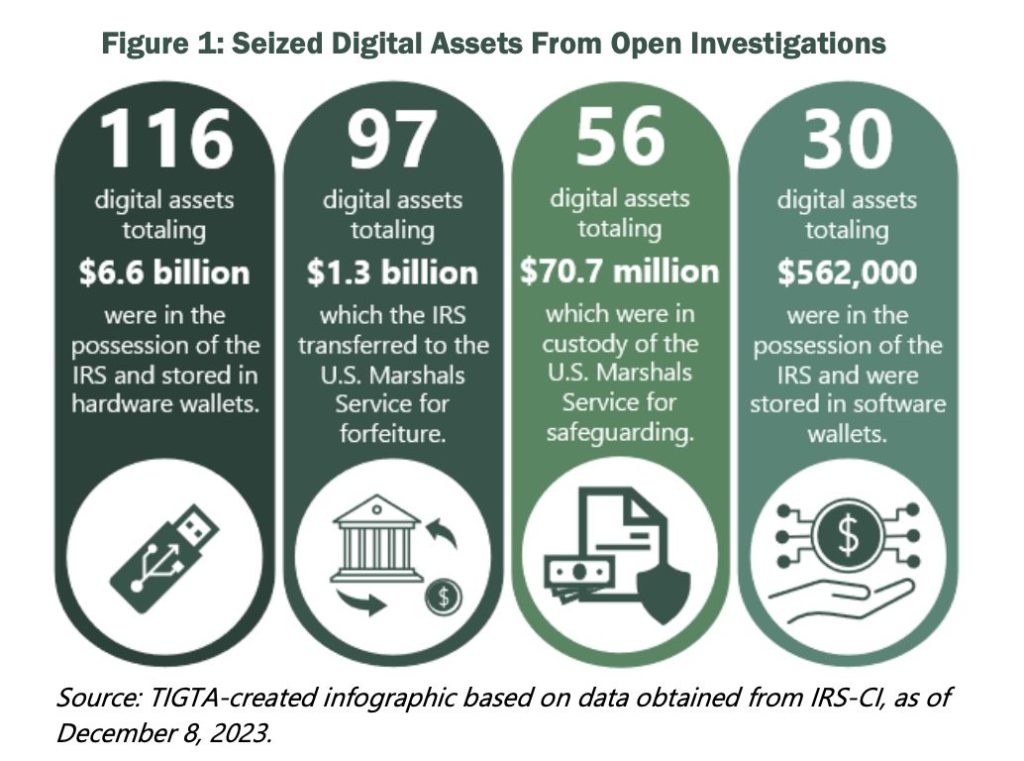
The Internal Revenue Service’s (IRS) criminal division has recently come under fire for its mishandling of seized cryptocurrency assets, as revealed in a report by the Treasury Inspector General for Tax Administration (TIGTA). The investigation highlighted significant deficiencies in how the IRS Criminal Investigation (IRS-CI) manages digital assets confiscated in criminal cases.
According to the report, as of late 2023, the IRS had custody of approximately $8 billion in digital assets related to ongoing investigations. However, TIGTA found that IRS-CI failed to consistently adhere to its own protocols for documenting these seizures, resulting in missing or inaccurate crucial data.
One of the primary issues identified was the absence of seizure memoranda, which are essential for formally documenting the transfer of digital assets to government-controlled wallets. Many seizures lacked these memos, and those that did often had incomplete information, such as missing wallet addresses, transaction amounts, or seizure dates. In one instance, wallet addresses were mistakenly swapped.
The report also raised more serious concerns, such as three hardware wallets that went missing after being transferred by the FBI. Additionally, IRS staff shredded the recovery seed phrase for a government wallet, jeopardizing permanent access to the funds. While the assets were eventually recovered, the report emphasized that such errors could have resulted in irretrievable losses.
Another notable issue highlighted in the report was the conversion of a Litecoin asset into Bitcoin during a seizure by IRS-CI, failing to preserve the asset in its original form. Subsequently, the agency updated its guidelines to retain seized cryptocurrencies in their native formats, following TIGTA’s concerns raised in May 2024.
Furthermore, recordkeeping discrepancies were identified in the IRS’s inventory system, AFTRAK, with approximately 43% of seized crypto assets inaccurately listed in the system. Several entries exhibited quantity discrepancies that could impact asset valuation, such as an undervalued bitcoin holding by over $9,000 due to a decimal error.
TIGTA issued six recommendations for IRS-CI to enhance inventory systems, clarify internal guidelines, and enforce documentation timelines. The IRS agreed to five recommendations and partially accepted the sixth, citing challenges in preserving asset types during seizures.
As the frequency of crypto seizures is expected to rise, the IRS faces mounting pressure to enhance its controls and prevent costly errors in handling seized digital assets. This underscores the importance of meticulous recordkeeping and adherence to established procedures to safeguard seized cryptocurrency assets effectively.