
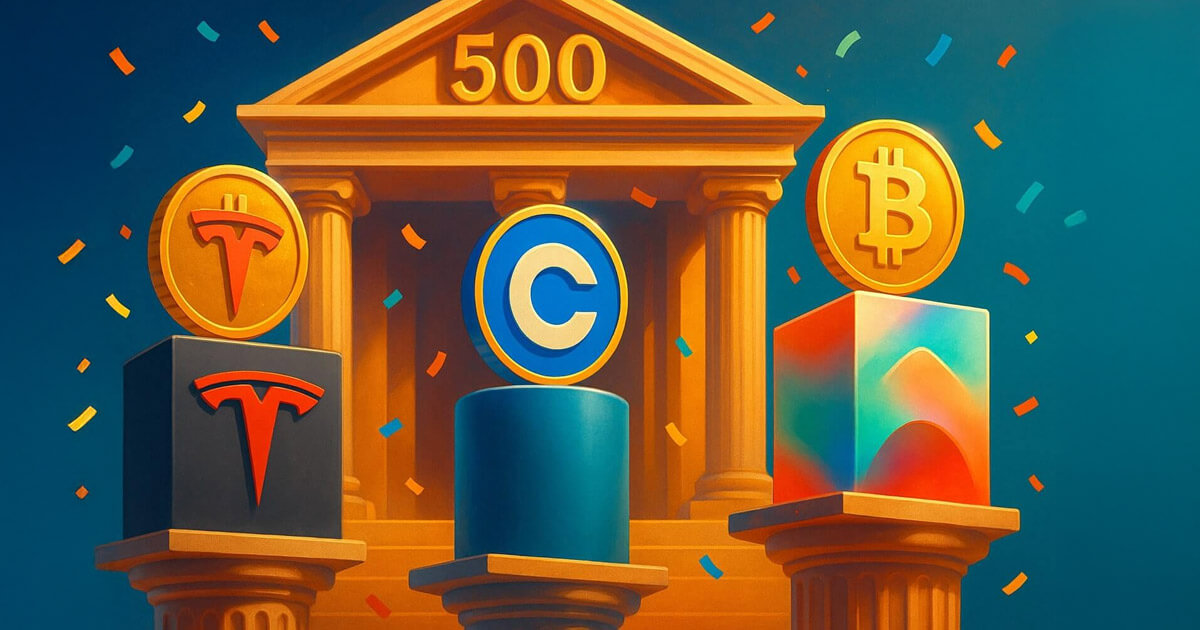
Block, a leading fintech company, made headlines recently by joining the S&P 500 on July 23, taking the spot of Hess after its acquisition by Chevron. This reshuffle caused Block’s stock to surge by 10.7% from $72.01 to $79.69. The announcement of this addition on July 18 led investors to position themselves ahead of index-tracking funds that needed to purchase shares to mirror the benchmark.
In a statement, Block referred to this move as a significant milestone that reflects the strength of their business and the hard work of their team in creating tools to enhance access to the economy. The company highlighted its diverse range of products including Square, Cash App, Afterpay, TIDAL, Proto, and Bitkey. Despite the price increase, Block’s shares are still down by 13% in the year-to-date timeframe.
Block now becomes the third publicly listed entity in the S&P 500 that holds Bitcoin in its treasury, following in the footsteps of Tesla and Coinbase. Tesla currently holds the tenth-largest Bitcoin treasury among publicly listed companies, with 11,509 BTC valued at nearly $1.4 billion. Coinbase, on the other hand, holds the twelfth spot with 9,267 BTC worth around $1.1 billion. With an 0.09% weight and 8,584 BTC in reported holdings, Block now owns $1 billion worth of Bitcoin.
The rally in Block’s shares showcases how index mechanics can intersect with sentiment around fintech companies, which have underperformed in the tech-led market this year. Membership in the S&P 500 can reduce perceived risk, attract mandate-limited institutional investors, and broaden the shareholder base. The company’s execution on its core businesses, including Square’s merchant services, Cash App’s consumer finance suite, and Afterpay’s Buy Now, Pay Later service, will be crucial in sustaining this rerating. Additionally, newer initiatives like the self-custody wallet Bitkey and music platform TIDAL contribute to diversification.
In conclusion, Block’s inclusion in the S&P 500 signifies a significant achievement for the company and highlights its position as a key player in the fintech industry. The future success of Block will depend on its ability to capitalize on its core businesses and continue to innovate in the ever-evolving financial technology space.