

In a groundbreaking new article, Ethereum co-founder Vitalik Buterin delves into the often overlooked topic of memory access time in computing and its implications for cryptographic systems. While the subject may seem highly technical, its impact on the efficiency of blockchains, cryptographic proofs, and AI models cannot be overstated.
Memory Access: A Critical Issue
Buterin challenges the conventional wisdom that memory access operations take a fixed amount of time, introducing a new model that ties memory access time to the cube root of memory size. This means that as memory size increases, the time required to retrieve data also increases, as signals have to travel longer distances within the memory structure.
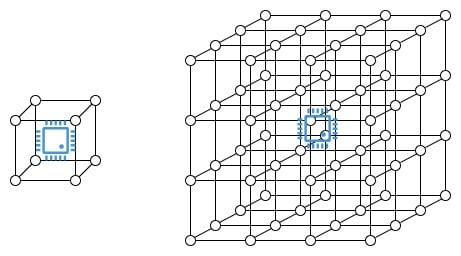
Real-world evidence supports this model, showing that access time indeed grows with memory size, from CPU caches to RAM. This insight has significant implications for algorithm optimization, especially in cryptography, where precomputing and storing intermediate results is common practice.
Enhancing Blockchain Memory Management
Buterin illustrates the impact of memory access time on blockchain security using elliptic curve cryptography as an example. Developers often precompute large tables of numbers to speed up processes, but if these tables become too large to fit in cache memory, the resulting slowdown can negate any performance gains. In a test scenario, a smaller cache-fitting table outperformed a larger RAM-stored table.
The key takeaway is clear: Cryptographic efficiency requires not just faster processors, but also intelligent memory management. Understanding and applying Buterin’s model could shape the future hardware optimization of blockchain and zero-knowledge systems, especially as the industry embraces specialized hardware like ASICs and GPUs.