
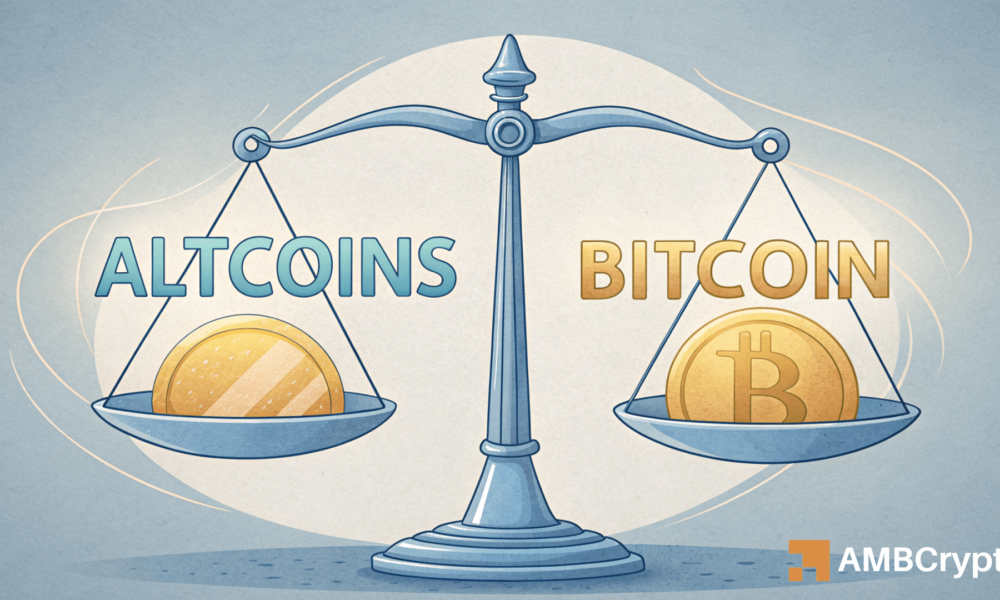
Altcoins are currently experiencing a significant shift in investor behavior, as large-scale withdrawals from Binance suggest a rising trend of accumulation. Ethereum, Chainlink, and Maker are among the top tokens witnessing consistent outflows, indicating that whales are moving their assets from exchanges to personal wallets for long-term accumulation. This trend is particularly interesting as it continues even without a confirmed altcoin season, hinting at quiet positioning ahead of a potential market rotation from Bitcoin to altcoins.
While Bitcoin’s dominance has held above 63%, recent data shows that altcoins like IP, FORM, and MKR are outperforming BTC in terms of returns. This divergence in performance, coupled with the ongoing accumulation of altcoins, suggests that the market may be on the brink of a transition.
Bitcoin’s dominance recently dropped from 65.81% to 63.44%, maintaining its broader ascending channel. The rebound in dominance reflects short-term BTC strength, but historical patterns indicate that altcoin rallies often begin when BTC dominance fails to make new highs. Therefore, if this recovery weakens, it could be a sign of capital flowing back into altcoins.
The Altcoin Season Index, currently at 22, indicates a Bitcoin season but has started to rise from previous lows, signaling building momentum for altcoins. While not yet in the altseason zone, the index’s movement suggests an early shift in sentiment. This transition, coupled with the ongoing accumulation trends and recent performance gains, indicates that the market could soon break out of Bitcoin dominance.
Despite Bitcoin’s 5.94% gain in the last 90 days, several altcoins have posted explosive returns. Tokens like IP, FORM, MKR, Pepe, and PENGU have outpaced Bitcoin with significant growth, indicating an increasing investor risk appetite outside of BTC. This outperformance highlights that altcoins are leading in terms of returns, despite BTC dominance appearing stable on the chart.
The market’s divergence, with Binance outflows indicating altcoin accumulation while BTC dominance remains firm, suggests a transitional phase. Traders should not rely solely on dominance metrics but also monitor accumulation trends and price performance to gauge market sentiment accurately. The accumulation trends, price outperformance, and early movement in the altcoin season index all point toward an upcoming shift in the market. If BTC dominance fails to break its current highs and altcoins maintain momentum, a broader rotation could unfold rapidly, indicating that investors are quietly preparing for a potential market shift. The Benefits of Meditation for Mental Health
Meditation has been practiced for centuries as a way to calm the mind, reduce stress, and promote overall well-being. In recent years, there has been a growing body of research showing that meditation can have significant benefits for mental health. From reducing symptoms of anxiety and depression to improving focus and concentration, meditation has the power to transform our mental state in profound ways.
One of the key benefits of meditation for mental health is its ability to reduce stress and anxiety. When we meditate, we enter a state of deep relaxation that allows us to release tension and quiet the mind. This can help to lower levels of cortisol, the stress hormone, and promote a sense of calm and peace. By practicing meditation regularly, we can train our minds to respond more calmly to stressors and challenges, reducing the negative impact of anxiety on our mental health.
Meditation has also been shown to be effective in managing symptoms of depression. By focusing on the present moment and cultivating a sense of gratitude and compassion, meditation can help to shift our perspective and increase feelings of positivity and well-being. Studies have found that regular meditation practice can lead to a reduction in depressive symptoms and an improvement in overall mood.
In addition to reducing stress and anxiety, meditation can also improve cognitive function and focus. By training our minds to be more present and attentive, we can increase our ability to concentrate and make decisions with clarity. This can be especially beneficial for those with attention deficit disorders or other cognitive challenges. Research has shown that meditation can lead to improvements in working memory, attention span, and cognitive flexibility.
Furthermore, meditation has been linked to changes in the brain that can have lasting effects on mental health. Studies have found that meditation can increase the volume of gray matter in areas of the brain associated with emotion regulation, self-awareness, and empathy. These changes can help to strengthen our mental resilience and ability to cope with stress and negative emotions.
Overall, the benefits of meditation for mental health are numerous and profound. By incorporating a regular meditation practice into our daily routine, we can experience improvements in our mood, focus, and overall well-being. Whether you are struggling with anxiety, depression, or simply looking to reduce stress and improve your mental health, meditation is a powerful tool that can help you to achieve greater peace of mind and emotional balance.