
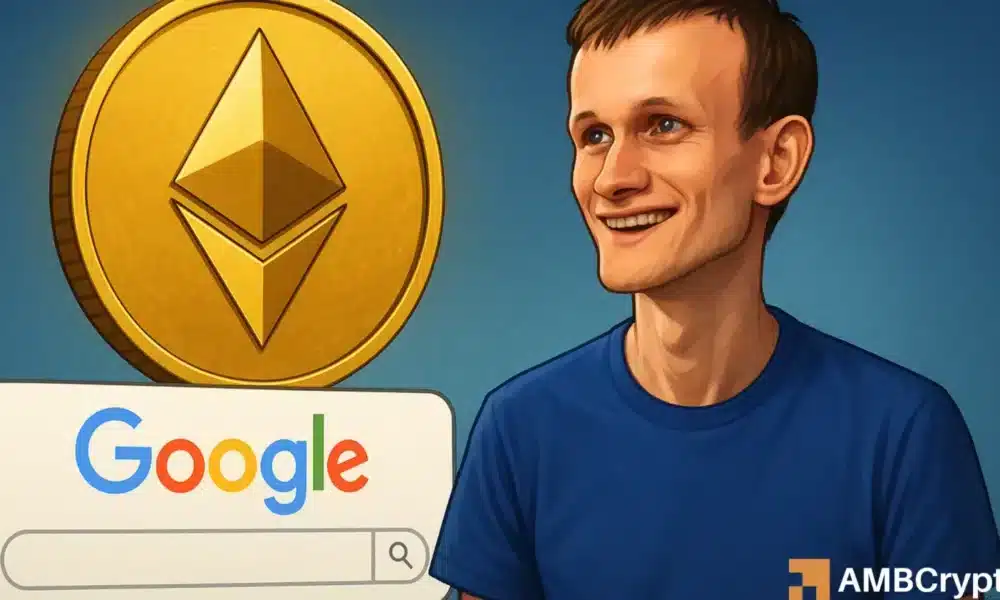
Ethereum [ETH] continues to captivate the crypto community, not just for its price movements but also for the recent shift in focus by co-founder Vitalik Buterin towards Ethereum’s long-term vision. In his recent blog post, Buterin emphasized the importance of using low-risk decentralized finance (DeFi) protocols to provide Ethereum with a stable economic foundation.
Drawing a parallel to Google Search sustaining Google, Buterin highlighted the significance of revenue generated from these DeFi protocols while ensuring that non-financial applications uphold Ethereum’s cultural and community-driven values. The Ethereum ecosystem has long grappled with a fundamental tension between revenue-generating applications and projects that align with Ethereum’s original mission and values.
On one hand, financial activities like NFTs, memecoins, and DeFi loops have generated significant capital but often rely on short-lived dynamics. On the other hand, non-financial projects like Lens, Farcaster, ENS, and privacy protocols showcase Ethereum’s technological depth but struggle with adoption and fee generation.
Buterin’s vision suggests that Ethereum may have found its “Google Search” moment in low-risk DeFi protocols, which could provide the network with a reliable economic foundation without compromising its spirit. Unlike Google’s profit-maximization approach, Ethereum’s decentralized structure aims to align financial success with community values.
Recent on-chain trends in Ethereum show a nuanced picture of the network’s momentum, with smaller wallet holders driving much of the activity. While ETH trades at $4,485.13, the distribution of addresses highlights a broad user base rather than heavy reliance on whales. Activity levels fluctuate, with spikes in engagement observed around mid-September.
However, Ethereum’s unstaking queue stretching beyond 45 days has drawn criticism, with users expressing frustration over delays in accessing funds for everyday needs. Buterin defended the longer wait, describing it as a necessary part of the network’s “security deal.”
In conclusion, Ethereum’s long-term vision, driven by Buterin’s insights, aims to strike a balance between revenue generation and upholding the network’s core values. As Ethereum navigates through these challenges, the community looks towards a future where the network can thrive economically while staying true to its decentralized ethos. The Virtual Reality Revolution: How VR is Changing the Way We Experience the World
Virtual reality (VR) technology has come a long way since its inception, and it is now being used in a variety of industries to revolutionize the way we experience the world. From gaming and entertainment to healthcare and education, VR is changing the way we interact with our surroundings and providing new and exciting opportunities for innovation.
One of the most well-known applications of VR technology is in the gaming industry. VR gaming allows players to fully immerse themselves in a virtual world, giving them a sense of presence and agency that traditional gaming cannot replicate. With the use of VR headsets and motion controllers, players can move around and interact with their environment in ways that were previously impossible. This has led to the development of a whole new genre of games that are specifically designed for VR, offering a unique and immersive experience that is unlike anything else.
But VR is not just limited to gaming. In the healthcare industry, VR technology is being used to provide new ways of training medical professionals and treating patients. Surgeons can now practice complex procedures in a virtual environment before performing them on real patients, reducing the risk of errors and improving outcomes. Patients suffering from anxiety disorders or phobias can also benefit from VR therapy, which allows them to confront their fears in a safe and controlled environment.
In the field of education, VR technology is revolutionizing the way students learn and interact with their subjects. Virtual field trips allow students to explore far-off locations without ever leaving the classroom, giving them a firsthand experience that is both engaging and educational. VR simulations can also be used to teach complex concepts in a way that is easy to understand and remember, making learning more interactive and fun.
But perhaps the most exciting application of VR technology is in the realm of social interaction. Virtual reality allows people to connect with others in ways that were previously impossible, breaking down barriers of distance and time. Virtual meetings and conferences are becoming more common, allowing colleagues to collaborate and communicate as if they were in the same room. Social VR platforms also allow friends and family members to hang out and play games together in a virtual space, creating new opportunities for bonding and shared experiences.
Overall, virtual reality technology is changing the way we experience the world in ways we never thought possible. With its ability to immerse us in new environments and provide new ways of interacting with our surroundings, VR is opening up a whole new world of possibilities for innovation and creativity. As the technology continues to evolve and improve, we can expect to see even more exciting applications of VR in the future.