
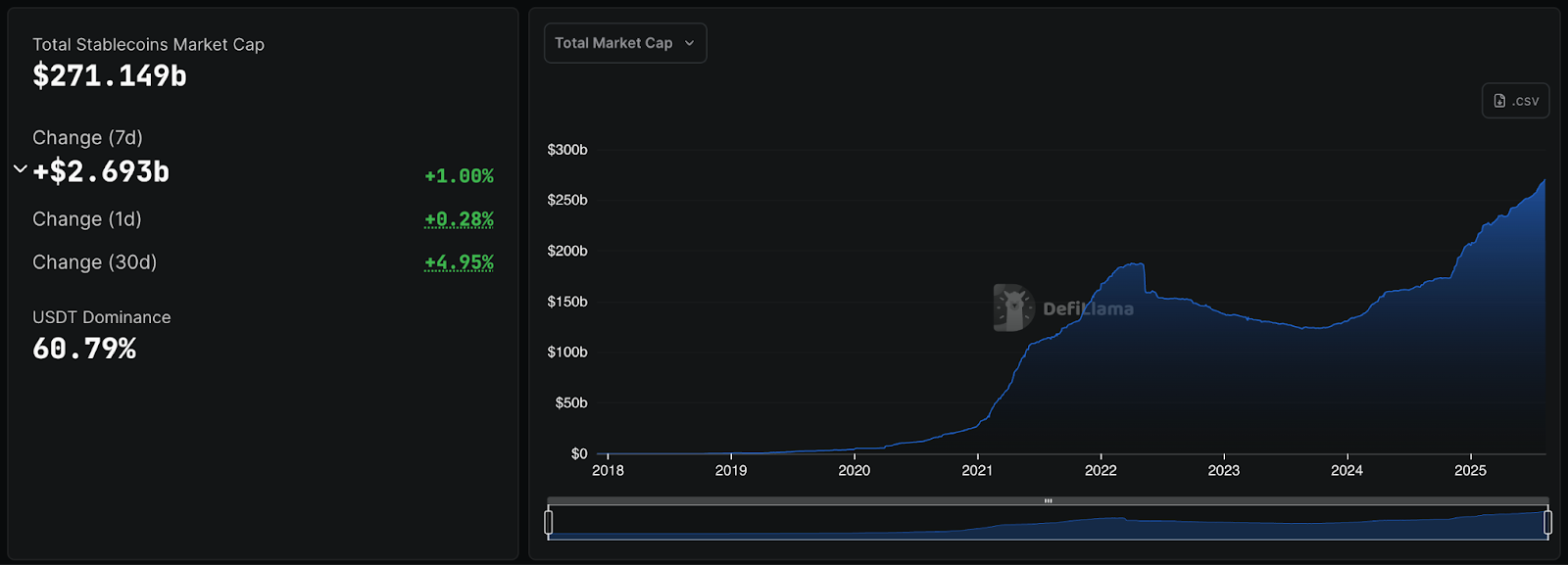
Visa’s head of crypto, Cuy Sheffield, is optimistic about the future of payments, predicting a blend of traditional and crypto transactions as the stablecoin market continues to surge. With the stablecoin market hitting $269 billion and growing by 62% over the past year, Sheffield envisions the market expanding to a staggering $2 trillion within the next three years.
Visa has been at the forefront of this trend, surpassing $200 million in cumulative stablecoin settlement volume. Rather than seeing stablecoins as a threat, the payments giant views them as an opportunity to bridge the gap between traditional finance and digital assets. Sheffield’s team at Visa has been proactive in expanding the company’s stablecoin settlement business, forging partnerships with major banks for token issuance, and securing deals with fintech firms globally.
In 2024, Visa launched its Visa Tokenized Asset Platform, which allows financial institutions to issue and manage tokens on blockchain networks. Spanish bank BBVA is set to launch a stablecoin on Ethereum using Visa’s platform, signaling a significant step towards mainstream adoption of digital assets.
The stablecoin market has been on a steady upward trajectory, reaching a total market capitalization of $261 billion in July. As of August 12, the market cap has grown to $271 billion, with over $2.6 billion added in the past week alone. Tether remains the leader with a $164 billion market cap, followed by USD Coin at $63.6 billion, and Ethena USDe at $7.60 billion.
The passage of the GENIUS Act in July established federal regulations for payment stablecoins, mandating full 1:1 backing by cash or liquid US Treasuries with monthly reserve disclosures. This legislation has sparked corporate interest, with companies like Western Union, Interactive Brokers, and Remitly exploring stablecoin integration for payment modernization.
Visa has been proactive in expanding its reach in the stablecoin market, partnering with Yellow Card Financial to enable stablecoin payments across 20 African countries. Similarly, Mastercard has announced a partnership with Chainlink to allow cardholders to purchase crypto directly on-chain through secure fiat-to-crypto conversion.
Traditional finance institutions are also embracing the blockchain revolution, with companies like Stripe developing a high-performance Layer 1 blockchain called “Tempo” focused on payments. Stripe has been strategic in its acquisitions, purchasing stablecoin infrastructure firm Bridge for $1.1 billion and crypto wallet developer Privy. The company has introduced stablecoin payments across 70 countries and launched Stablecoin Financial Accounts for companies in 101 countries.
Despite some skepticism from JPMorgan about the growth of stablecoins, Federal Reserve Governor Christopher Waller believes that stablecoins can play a crucial role in maintaining the US dollar’s status as the world’s reserve currency. As adoption of stablecoins accelerates across various sectors, it is clear that the future of payments will be a blend of traditional and crypto transactions.
Overall, the convergence of traditional finance and digital assets is paving the way for a new era of payments, with stablecoins playing a central role in this transformation. As the market continues to expand and evolve, companies like Visa and Stripe are well-positioned to capitalize on the opportunities presented by this rapidly growing sector.