
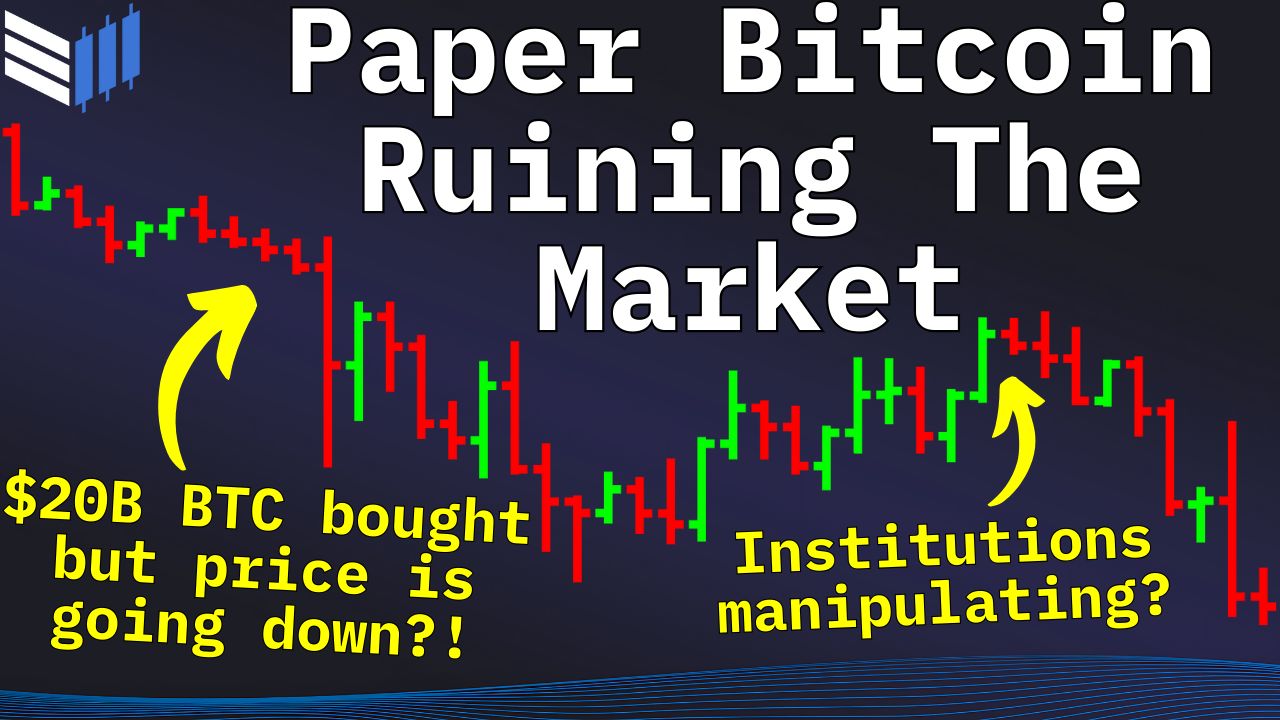
The recent stagnation of the bitcoin price has left many investors scratching their heads. Despite significant accumulation by institutions and treasury companies, the price of bitcoin has remained relatively flat. This has led to speculation about the impact of “paper Bitcoin” on the market, as well as the dynamics of supply and demand.
In a recent video analysis titled “Paper Bitcoin Ruining The Bitcoin Bull Market,” I delved into on-chain data, treasury holdings, and derivatives activity to unravel the true factors influencing the bitcoin price.
Institutional Accumulation vs. Bitcoin Price Stagnation
In recent months, ETFs and treasury companies have accumulated an estimated 200,000 BTC, bringing total treasury holdings close to 1 million Bitcoin. Despite this influx of institutional demand, the bitcoin price has failed to reflect this accumulation, remaining stagnant after briefly reaching new all-time highs.
The reason for this disconnect lies in profit-taking by long-term holders. Over 450,000 BTC have moved from long-term wallets to newer, short-term market participants since July, offsetting the bullish impact of institutional inflows on the bitcoin price.
Long-Term Holders Taking Profits
On-chain data reveals selling pressure from investors holding Bitcoin for four to ten years. These long-term holders, who accumulated at lower prices, are now capitalizing on profits as the price of bitcoin surges to record levels.
Historically, long-term holders tend to reduce their exposure as the market heats up, only to re-accumulate once the frenzy subsides. Current HODL waves data indicates that selling pressure from this group is increasing, contributing to the sideways movement in the bitcoin price.
The Derivatives Factor
Another factor influencing bitcoin price action is the rise in futures and options activity. Open interest in derivatives has grown by approximately 50,000 BTC across exchanges since July. While this doesn’t directly confirm the existence of “paper Bitcoin,” it does suggest that capital is flowing into leveraged bets rather than spot accumulation, limiting upward pressure on the bitcoin price.
The expansion of CME futures and options markets has further magnified the impact of derivatives on short-term price movements. As a result, more liquidity is tied up in contracts, reducing direct buy pressure on BTC.
Supply and Demand in Motion
While some may suspect manipulation through paper claims, the evidence suggests that what we’re witnessing is simply real-time supply-and-demand dynamics at play:
– Approximately 200,000 BTC accumulated by institutions.
– Over 450,000 BTC distributed by long-term holders.
– 50,000+ BTC tied up in derivatives markets.
When these factors are considered together, it becomes clear why the bitcoin price has struggled to break out despite strong institutional demand.
What’s Next for Bitcoin Price?
While short-term conditions may point to continued consolidation, this doesn’t necessarily signify a market top. If funding rates turn negative, a short squeeze could propel the bitcoin price higher. However, the current imbalance between accumulation and distribution suggests that sideways movement may persist.
Looking ahead, the bull market for Bitcoin remains intact. Investors concerned about “paper Bitcoin” should take solace in the ongoing spot accumulation happening behind the scenes. Without this accumulation, the bitcoin price would likely be trading much lower than its current levels.
For more in-depth data, charts, and expert insights on bitcoin price trends, visit BitcoinMagazinePro.com.
Subscribe to Bitcoin Magazine Pro on YouTube for additional market analysis and insights.
Disclaimer: This article is for informational purposes only and should not be construed as financial advice. Always conduct your own research before making investment decisions.