
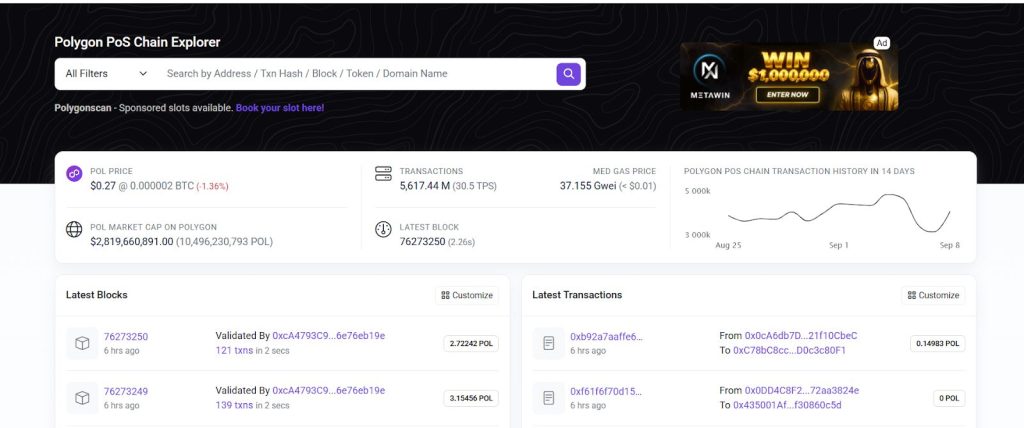
The Polygon PoS Network is currently experiencing a network finality delay due to a node bug affecting Bor and Erigon nodes, resulting in transactions taking 10-15 minutes to complete. This issue has been confirmed by an official incident report from the Polygon Foundation.
The disruption began early on Wednesday and has impacted several Remote Procedure Call (RPC) services, causing accessibility problems for applications built on the network. The Polygon team has identified the bug as hindering node advancement for specific configurations.
Restarting affected nodes has proven to be successful in resolving the issue for some participants. According to Polygon, “We observe that restarting nodes has resolved the issues for numerous validators and RPC providers.”
As of now, the most recent block on the Polygon network was generated over 6 hours ago, as indicated by Polygonscan. However, users have been directed to a Bor Mainnet displaying block updates with over 102 active nodes.
In response to the downtime incident, the Polygon token (POL) has seen a negative reaction in the market, currently trading at $0.2669 with a $2.8 billion market cap. POL has declined by 3.42% today, extending its year-to-date drop to 30.3%.
Data from DeFiLlama shows that Polygon has experienced a significant decrease in Total Value Locked (TVL) since its peak in June 2021, dropping from $9.432 billion to $1.2 billion.
Several protocols have suspended Polygon transactions to prevent finality and reversal complications. TokenPocket, a popular multichain stablecoin wallet, has informed its users that all on-chain transactions on Polygon are temporarily halted.
Transaction finality is crucial as it ensures that a trade cannot be reversed once confirmed by the network. Delays in finality force exchanges and DeFi apps to wait longer before processing deposits or trades to ensure the security of user funds.
In a separate incident, Linea network also experienced a temporary outage, raising questions about a potential connection with the Polygon disruption. Both networks are Ethereum Layer-2 scaling solutions.
Despite the challenges, the Polygon team has been proactive in addressing network disruptions. In July, they implemented the Heimdall upgrade to improve stability and validator coordination, aiming to reduce transaction finality to just five seconds.
Overall, the recent network disruptions highlight the complexities of scaling solutions in the crypto space. While challenges may arise, continuous improvements and upgrades are essential to ensure the long-term success and stability of blockchain networks like Polygon.