
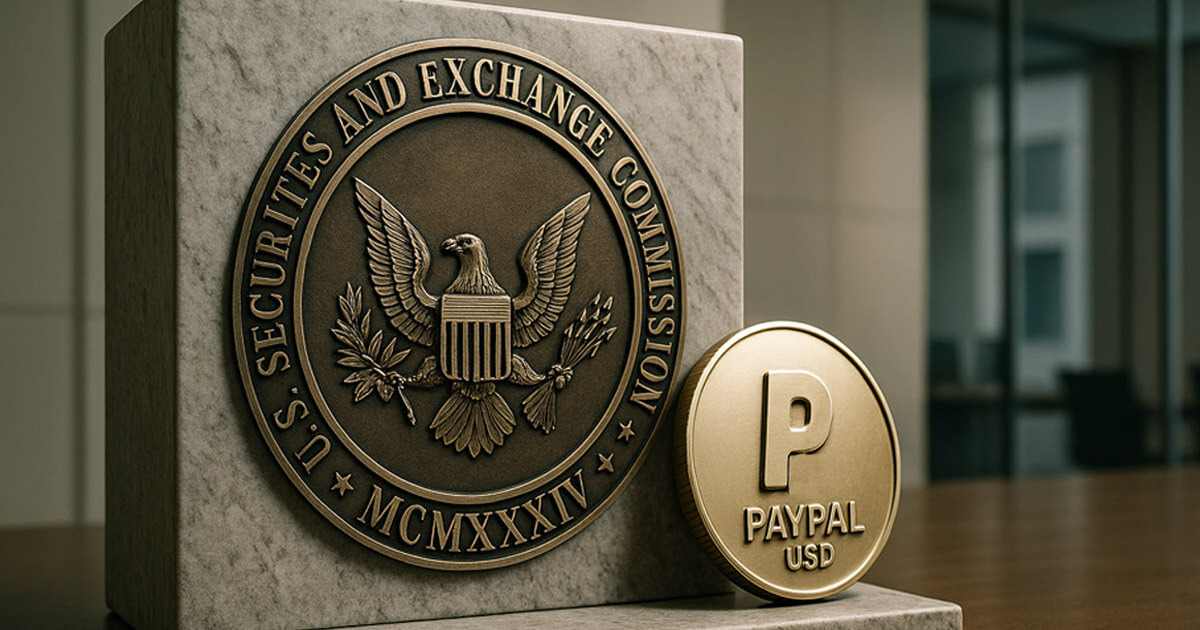
The U.S. Securities and Exchange Commission has officially closed its investigation into PayPal’s dollar-backed stablecoin, PYUSD, without pursuing any enforcement action, as revealed in the company’s latest 10-Q filing.
This decision, disclosed in the Q1 2025 financial report, marks the end of a scrutiny that began with a subpoena issued in November 2023. The industry had been speculating on whether PYUSD would be classified as an unregistered security.
The resolution of this matter removes a potential legal threat for both PayPal and Paxos, the issuer of PYUSD. It also indicates a cautious regulatory approach towards certain stablecoin frameworks.
The SEC’s subpoena had requested a wide range of documents related to PYUSD activities but did not specify any violations. The agency’s choice aligns with recent actions taken since Gary Gensler’s departure, who often argued that many tokens could be classified as securities.
The fact that PYUSD is now exempt from further investigation could lend support to the GENIUS Act, a bipartisan Senate bill known as S. 919. This bill proposes a distinct regulatory path for payment stablecoins, outlining licensing requirements, reserve backing ratios, and disclosure obligations.
Paxos, a New York Department of Financial Services-regulated trust company, introduced PYUSD in August 2023 as the first payments-branded stablecoin from a major U.S. fintech firm. The stablecoin is fully backed by cash and short-term U.S. Treasury bills, with regular attestations published.
PayPal has integrated PYUSD into its platforms, including Venmo, and has enabled external ERC-20 transfers. Although PYUSD’s circulating supply is relatively small at around $879 million, it represents less than 0.5% of the global stablecoin market valued at $241 billion.
Coinbase recently waived trading fees for PYUSD and introduced one-click redemption to USD, potentially enhancing liquidity and user experience for those transacting with the token.
Despite its modest market share compared to established stablecoins like USDT and USDC, PayPal views PYUSD as a cornerstone of its stablecoin strategy. The company plans to offer more than 20 million small businesses the option to settle payments in PYUSD by the end of 2025, positioning itself to bypass traditional card networks and establish native stablecoin-based payment channels.
While PayPal acknowledges uncertainties regarding custodial and legal aspects of digital asset storage, the absence of SEC enforcement in the PYUSD case provides some clarity in a regulatory landscape that remains fragmented.
The SEC’s decision coincides with ongoing regulatory inquiries into other aspects of PayPal’s operations, such as a Civil Investigative Demand from the Consumer Financial Protection Bureau related to PayPal Credit’s backup funding and an antitrust review by Germany’s Federal Cartel Office. However, these matters do not pertain to PYUSD or its crypto-related functions.
The SEC’s recent statement in April clarified that a specific subset of USD-backed, fully reserved, non-yield-bearing stablecoins (“Covered Stablecoins”) is not considered a security under federal securities laws. While this guidance is not comprehensive and does not constitute formal rulemaking, it suggests that enforcement may not be the primary mechanism for shaping regulations on dollar-backed tokens.
Overall, the retreat of the SEC in the PYUSD case underscores the possibility that stablecoin oversight and rules may ultimately be determined by Congress rather than through regulatory enforcement.