
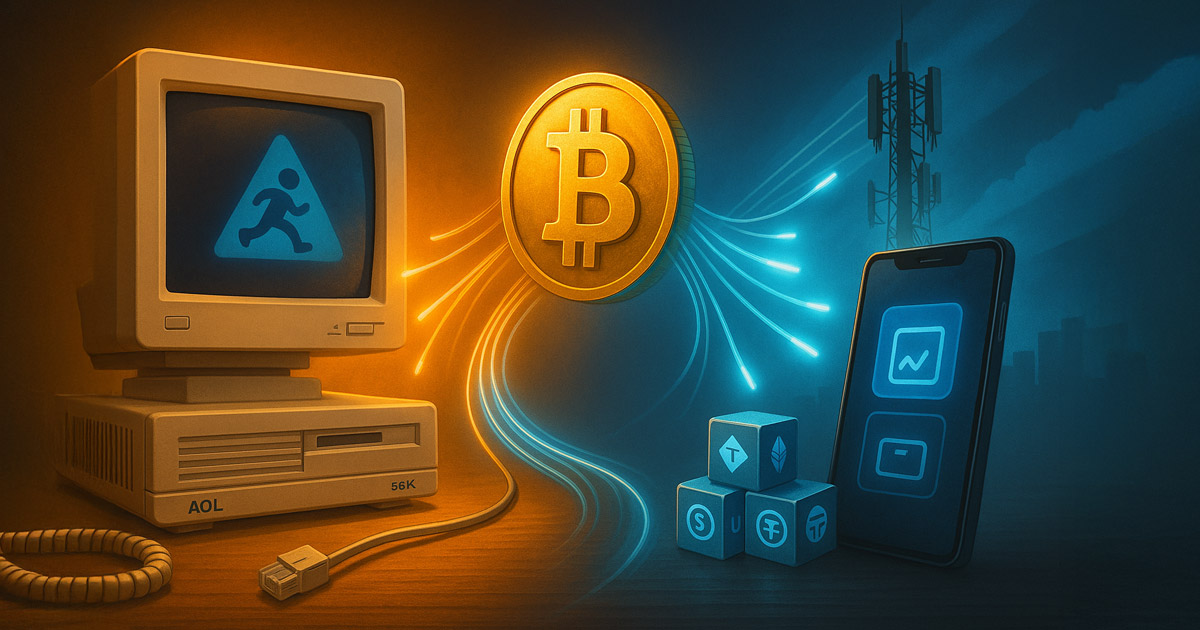
AOL discontinued dial-up internet access on September 30, 2025, marking the end of an era for the access service. While AOL Mail and other products remain operational, the AOL Dialer and AOL Shield have been retired, with instructions provided for users to transition off legacy connections.
The shutdown of dial-up internet access by AOL impacts a small fraction of U.S. households. This development comes at a time when the crypto markets are evolving with new access channels that are reshaping how investors engage with Bitcoin without altering the essence of Bitcoin itself.
Drawing parallels between the dial-up internet era and the current state of Bitcoin adoption, it is important to note that Bitcoin serves as both a monetary asset and a base settlement protocol. Just as dial-up was a means to connect to the Internet, various custodial front ends, exchange on-ramps, and second-layer user experiences in the crypto space act as access points that evolve with changing technology and regulations.
The comparison between the growth of the Internet and the adoption of Bitcoin remains relevant. While dial-up paved the way for broadband and mobile internet access, the core network of the Internet persisted and expanded. Similarly, in the crypto space, ETFs, stablecoins, and Layer-2 solutions serve as access rails that complement the foundational monetary layer of Bitcoin.
The shift in capital access has been rapid, particularly with the introduction of spot Bitcoin ETFs in the United States. These ETFs have simplified access to Bitcoin for institutions and advisors, streamlining the process of acquiring exposure to Bitcoin through brokerage accounts. Inflows into Bitcoin products have remained steady, reflecting the growing interest and participation in the crypto market.
Data on crypto ownership and on-chain activity provide insights into the evolving landscape of digital assets. While the number of crypto owners globally continues to increase, on-chain metrics like active addresses and Lightning Network capacity indicate shifts in user behavior and transaction patterns. The emergence of various access points and custodial solutions underscores the versatility of Bitcoin as a store of value and a medium of exchange.
Looking ahead, the integration of Bitcoin into traditional financial systems and the development of user-friendly interfaces will play a crucial role in expanding the user base and driving adoption. As with the transition from dial-up to broadband internet access, innovations in the crypto space will continue to enhance accessibility and usability without replacing the core principles of Bitcoin.
In conclusion, while AOL’s dial-up service may have come to an end, the essence of Bitcoin and its underlying network remain resilient and adaptable. As new access channels emerge and the crypto ecosystem evolves, Bitcoin’s position as a foundational monetary asset is set to endure, paving the way for broader participation and integration into mainstream financial systems.