
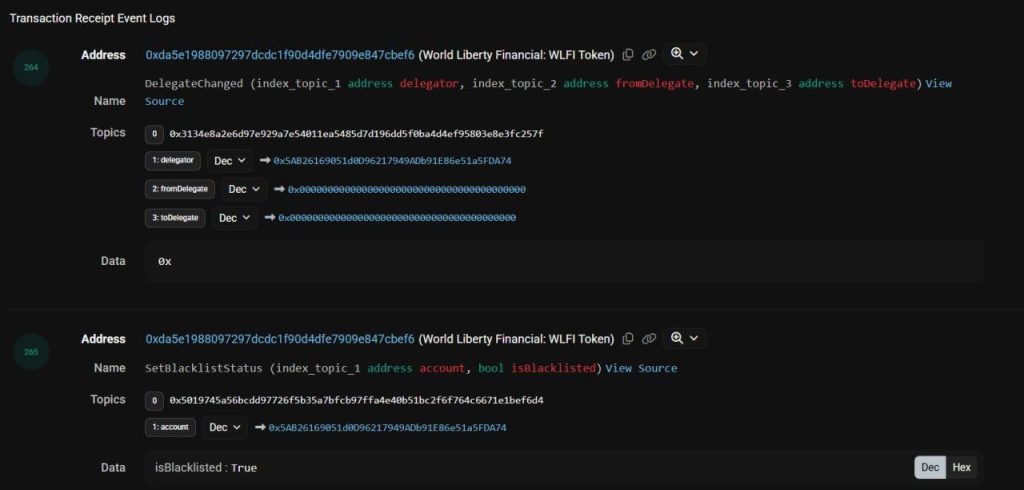
World Liberty Financial’s governance token, WLFI, saw a significant 8% increase in value on Tuesday, resulting in a $400 million boost to its market capitalization. This surge came after project leaders made the decision to freeze the holdings of crypto entrepreneur Justin Sun, causing a substantial shift in the token’s liquidity profile just days after its tumultuous launch.
The project leaders took action by blacklisting Sun’s wallet address, effectively locking up 540 million unlocked WLFI tokens valued at around $101 million, as well as 2.4 billion staked tokens worth approximately $452 million. In total, nearly 3 billion tokens were frozen as a result of this move.
Allegations had surfaced regarding an exchange engaging in the systematic selling of user deposits, putting pressure on the market. Core project leaders, along with several major exchanges, were reportedly involved in the decision to freeze Sun’s holdings.
The immediate impact of the freeze was a tightening of the circulating supply, alleviating potential selling pressure and pushing the price of WLFI back above $0.18. This increase provided a temporary reprieve for investors following a rocky launch that saw insiders selling off close to 700 million tokens within hours of trading commencement.
World Liberty Financial introduced its token on September 1 at an initial price of $0.46. However, heavy selling on platforms like Binance, OKX, and Gate swiftly drove the price down to $0.25 within two hours. While early backers who had acquired tokens in presale rounds at lower prices exited with substantial gains, retail investors faced losses.
Criticism was directed at the token’s economics, with approximately 56% of the supply controlled by insiders and entities associated with the Trump family holding 22.5 billion tokens, along with rights to 75% of the project’s revenues. Despite being marketed as a decentralized Trump-backed initiative, skeptics pointed out signs of centralization.
Justin Sun’s involvement in the project, including a $75 million investment and an advisory role, drew scrutiny. Recent data revealed that he had claimed $178 million worth of unlocked WLFI, bringing his total holdings to nearly $900 million before the freeze. On-chain movements between his wallets and HTX, an exchange he is affiliated with, led to allegations of market manipulation, which Sun vehemently denied.
In response to the controversy, WLFI’s official account emphasized that tokens in project-controlled wallets are subject to community votes rather than the team’s discretion. The freeze raised questions about investor redemptions, particularly regarding users seeking to reclaim their assets from HTX.
Despite the turbulent market conditions, WLFI’s team remains committed to its governance framework, allowing the community to influence future decisions.
In a bid to stabilize the market following steep losses, World Liberty Financial burned 47 million tokens in its first week of trading. This move, amounting to 0.19% of the circulating supply, was aimed at mitigating the impact of a 31% drop in WLFI’s price from its launch value of $0.33 to just over $0.23.
Furthermore, the team proposed a buyback-and-burn program funded by protocol fees, subject to community approval. While the burn helped alleviate some pressure, WLFI continued to experience a downward trend, with whales bearing the brunt of heavy losses.
Whales, including wallet addresses 0x432, 854RaR, and 0x1527, faced substantial unrealized losses as the token’s value plummeted. Despite efforts to reverse the decline, including the token burn, WLFI’s price dropped an additional 18% in the 24 hours following the announcement.
As World Liberty Financial transitions from hype to utility, investor confidence remains fragile, underscoring the challenges faced by celebrity-driven crypto projects. Whales are left grappling with significant losses, highlighting the risks associated with volatile market conditions.
Overall, the journey of WLFI reflects the complexities and uncertainties inherent in the cryptocurrency space, underscoring the importance of transparency, community governance, and risk management in navigating this evolving landscape.