
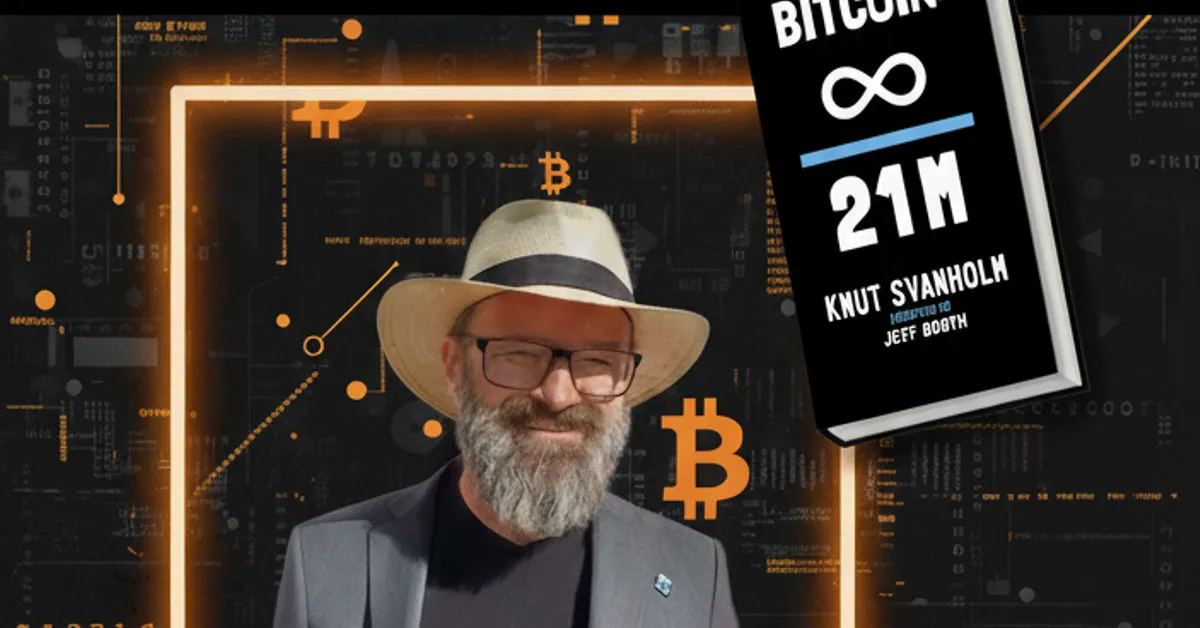
Knut Svanholm, the Swedish author, Bitcoiner, podcaster, and educator, is a prominent figure in Bitcoinland known for his eccentric yet charismatic persona. With a scruffy beard and a cowboy hat, Svanholm’s enchanting voice and funky demeanor have captured the attention of many in the Bitcoin community.
Having established the publishing house Lemiscate Media in Estonia with his co-author Luke de Wolf, Svanholm has taken a unique approach to book publishing. By accepting sats and keeping bitcoin on the balance sheet, Lemiscate has become a bitcoin treasury company, offering a workaround to Amazon’s book publishing gatekeeping. This move has allowed all of Svanholm’s previous books, including “Everything Divided by 21 Million” and “The Inverse of Clown World,” to be available via Lemiscate.
In a recent interview with Bitcoin Magazine, Svanholm delved into various topics, including publishing books in the modern age, praxeology (the arcane science underpinning Austrian economics), spirituality, nation-states, and the cooperative nature of Bitcoin. He emphasized the importance of leaning into “the fun” as a path to the bright future he envisions for Bitcoin.
When asked about his publishing company, Svanholm mentioned his admiration for Saifedean Ammous but clarified that his approach was not a deliberate copy. He highlighted his upcoming release, a course based on his book “Praxeology: The Invisible Hand That Feeds You,” which echoes Ammous’ work but with a more accessible style.
Reflecting on the reception of his books, Svanholm acknowledged the challenges of standing out in a crowded market of Bitcoin literature. He expressed his long-term goal of assembling all of his works into a collected volume and discussed the role of his podcast, Bitcoin Infinity Show, in deepening the convictions of seasoned Bitcoiners.
Despite the serious topics discussed, Svanholm’s podcast is known for its humor and entertainment value. He emphasized the importance of delivering engaging content and highlighted the success of the Satoshi Rockamoto pop-up concert events that he organizes with fellow Bitcoin enthusiasts.
In a candid conversation, Svanholm shared his views on Bitcoin, emphasizing the human element behind the digital currency. He discussed the blurred line between satoshis and personhood, highlighting the role of human action in upholding the rules of the Bitcoin network. Svanholm’s insights underscored the unique social and economic principles that underpin the success of Bitcoin.
Overall, Knut Svanholm’s blend of intellect, creativity, and humor has solidified his position as a respected voice in the Bitcoin community. As he continues to explore new avenues in publishing, education, and entertainment, Svanholm remains a compelling figure in the ever-evolving world of cryptocurrency and finance. Bitcoin’s impact on society and economics is profound, yet often overlooked. In a recent conversation between Knut and JB, the unique features of Bitcoin were discussed in detail, shedding light on how it changes the dynamics of trade, work, and wealth accumulation.
One of the key points made was that Bitcoin has shifted the balance of power in transactions by making it impossible for an aggressor to know the exact amount of sats (Bitcoin units) their victim possesses. This reduces the incentive for violence and encourages cooperation and fair trade. This aspect of Bitcoin is revolutionary and has far-reaching implications for the future of commerce.
Furthermore, the discussion touched on the concept that in a Bitcoin economy, individuals are incentivized to create value first before expecting rewards. This is a stark contrast to fiat jobs where employees are paid hourly regardless of the value they bring to the table. In a Bitcoin-centric world, real salaries can increase over time due to the deflationary nature of the currency, leading to a more equitable distribution of wealth.
The conversation also delved into the idea that in a deflationary economy, quality transactions take precedence over quantity. With a richer society, there are fewer but more significant transactions, leading to a more efficient and productive economy. This challenges the conventional wisdom that economic growth is solely dependent on the volume of transactions, highlighting the importance of quality over quantity.
Overall, the discussion highlighted the transformative power of Bitcoin in reshaping traditional economic models and incentivizing cooperation, value creation, and wealth accumulation. As more individuals and businesses embrace Bitcoin, we can expect to see a shift towards a more equitable and efficient economy based on trust, cooperation, and value creation. When you accept a receipt for something and you don’t receive the thing back, that’s theft. And that’s what banknotes are. In a recent conversation with Knut Svanholm, author of “Independence Reimagined,” the discussion delved into the concept of money, property rights, and the collective delusions that shape our society.
Knut pointed out that throughout history, humans have invented systems of cooperation and herd behavior, often driven by self-interest rather than the greater good. He highlighted the dangers of organized religion and nation-states, which have often been used to manipulate individuals into acts that serve the interests of a select few.
The conversation then shifted to the role of economics and praxeology in shaping human behavior and societal structures. Knut emphasized the importance of recognizing the ethical implications of economic practices, such as interest rates, and how these principles can be used to create a more just society.
The discussion touched on the idea of absolute property rights and argumentation ethics, which posit that certain axioms, such as the ownership of one’s body, form the basis for ethical behavior and societal organization. Knut argued that these principles are sound and can lead to a more equitable and cooperative society if embraced.
Despite the simplicity and logic of these ideas, Knut acknowledged that they are often overlooked or dismissed by the general public. He attributed this to the influence of government-funded institutions, such as public schools, which promote obedience and conformity rather than critical thinking and individual value.
In addressing how to address these issues and create positive change, Knut proposed the use of bitcoin as a tool for decentralizing power and disarming those who seek to exploit others. By engaging in transactions using bitcoin, individuals can bypass traditional financial systems and assert their autonomy and financial sovereignty.
Ultimately, Knut and his interlocutor agreed that change will come slowly, one person at a time. By spreading awareness about the benefits of bitcoin and challenging the status quo, individuals can gradually shift the balance of power away from centralized institutions and towards a more equitable and just society. Bitcoin: The Future of Currency
In a recent conversation, two individuals discussed the varying levels of interest in Bitcoin among people they encountered. One man they met had zero interest in Bitcoin, while a server they encountered at dinner was eager to learn more about it. The difference, they concluded, was that the server had a curiosity that had been awakened, while the man did not.
The conversation delved into the reasons why some people are hesitant to embrace Bitcoin. One major hurdle is the amount of time and effort required to truly understand how Bitcoin works. Most people simply do not have the time or inclination to invest the necessary hours into educating themselves about it.
However, in a country like Finland, where people have more leisure time and higher real wages, there is certainly the opportunity to devote time to learning about Bitcoin. The conversation touched on the fact that many people are content to work, come home, and feel like they have made a living for themselves, without delving deeper into how their money is being used by the government and banks.
Despite the challenges posed by democracy, taxes, and inflation, the conversation turned to the power of the free market. It was noted that everything good in the world comes from the free market, which is a more powerful force than any totalitarian leader could ever be.
Looking to the future, one participant expressed hope in Bitcoin as a beacon of light. They believe that the future lies in Bitcoin, and that it offers a way to move away from the darkness of totalitarian oppression. Without Bitcoin, they admitted they would be much less hopeful for the future.
Bitcoin is seen as a system that is easy to learn and understand, and when a system is better, people naturally make the change. The conversation ended on a positive note, with the belief that the world with Bitcoin is a beautiful one.
In conclusion, Bitcoin is seen as the future of currency, offering a way to move away from traditional financial systems towards a brighter, more decentralized future. The conversation highlighted the importance of education and curiosity in embracing new technologies, and expressed hope for a world where Bitcoin plays a central role in shaping a better future for all. the perspective of a travel blogger exploring the vibrant and bustling city of Tokyo, Japan.
Welcome to Tokyo, the bustling metropolis that seamlessly blends ancient traditions with modern technology. As a travel blogger, I had always dreamed of exploring this vibrant city and immersing myself in its unique culture. From the bustling streets of Shibuya to the serene temples of Asakusa, Tokyo offers a diverse array of experiences that will captivate any traveler.
One of the first things that struck me about Tokyo was the sheer size and scale of the city. The sprawling metropolis is home to over 13 million people, making it one of the most populous cities in the world. Despite its size, Tokyo is incredibly well-organized and efficient, with a reliable public transportation system that makes it easy to navigate the city.
My first stop in Tokyo was Shibuya, known for its iconic crossing that sees thousands of pedestrians crisscrossing the street with each traffic light change. The energy and excitement of Shibuya are infectious, with neon lights, bustling shops, and trendy cafes lining the streets. I spent hours exploring the quirky boutiques and sampling the delicious street food, soaking in the vibrant atmosphere of this lively neighborhood.
Next, I visited the historic district of Asakusa, home to the famous Senso-ji Temple. As I entered the temple grounds, I was struck by the peaceful atmosphere and the intricate architecture of the buildings. I made my way through the bustling Nakamise shopping street, browsing the stalls selling traditional snacks and souvenirs. Climbing the steps to the main hall of the temple, I took a moment to soak in the spiritual ambiance and reflect on the centuries of history that surrounded me.
No visit to Tokyo would be complete without indulging in the city’s world-renowned cuisine. From fresh sushi at the Tsukiji Fish Market to piping hot bowls of ramen at a local izakaya, Tokyo offers a culinary experience like no other. I made it a point to sample as many dishes as possible, from savory okonomiyaki to sweet taiyaki, and each meal was a delightful adventure for my taste buds.
As I explored Tokyo further, I discovered the city’s dedication to preserving its traditional culture while embracing innovation and technology. I marveled at the futuristic skyscrapers of Shinjuku and the serene gardens of Rikugien, finding beauty and tranquility in every corner of this dynamic city.
In conclusion, Tokyo is a city that offers a perfect blend of old and new, traditional and modern. From the bustling streets of Shibuya to the tranquil temples of Asakusa, every corner of Tokyo has something unique and exciting to offer. As a travel blogger, I can confidently say that Tokyo is a must-visit destination for anyone looking to experience the rich culture and vibrant energy of Japan.