
Tron founder Justin Sun has recently taken legal action against Bloomberg, filing a lawsuit in the US District Court for the District of Delaware. The lawsuit aims to prevent Bloomberg from disclosing sensitive details of his cryptocurrency holdings, which Sun argues would invade his privacy and pose a risk to him and his family.
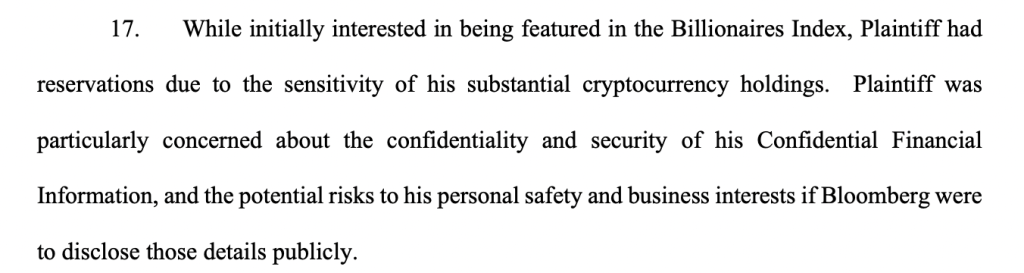
According to Sun’s complaint, Bloomberg had approached him earlier this year with the proposition of including him in its online Billionaires Index, a ranking of the world’s wealthiest individuals. Sun claims that before agreeing to participate, Bloomberg assured him that any asset information he provided would be kept strictly confidential, especially regarding his cryptocurrency holdings, and would only be used to verify his net worth.
Sun, the founder of Tron and a prominent figure in the blockchain industry, asserts that he agreed to share his detailed wallet and asset data with Bloomberg’s wealth verification team based on these assurances. He believed that any mention of his crypto assets in his profile would be limited to a lump sum valuation and would not include a breakdown by token type.
However, Sun alleges that Bloomberg breached this confidentiality agreement by including a detailed breakdown of his cryptocurrency holdings in a draft profile, which he claims contained numerous inaccuracies. Sun argues that such granular disclosure is not typical for Bloomberg’s Billionaires Index and goes beyond what is publicly disclosed for other crypto billionaires like Brian Armstrong of Coinbase or Changpeng Zhao of Binance.
Sun further contends that the publication of his detailed crypto holdings could make him a target for hackers and thieves, potentially exposing him to physical attacks. He points out that public blockchain transparency makes it relatively easy to identify large wallets once the asset composition is known, citing past incidents where wealthy crypto holders have faced kidnapping or extortion attempts.
In his lawsuit, Sun asserts two claims: public disclosure of private facts and promissory estoppel. He argues that Bloomberg’s planned publication violates the promises made to him and could have lasting financial and physical consequences, given the irreversible nature of crypto transactions. The lawsuit seeks a temporary restraining order, preliminary and permanent injunctions to block Bloomberg from publishing the breakdown, reimbursement of legal costs, and a jury trial.
For Sun, this legal battle is not just about media coverage but also highlights the tension in the crypto industry between transparency and personal security for high-value holders. Sun believes that revealing his detailed holdings could have far-reaching implications beyond a single news profile, emphasizing the importance of protecting sensitive financial information in the digital age.